The paperwork for junking a California car depends on the vehicle’s records and the receiving yard. Don’t rely on a universal document list. Confirm ownership, ask what the yard accepts, and verify the current DMV process before pickup.
Confirm who owns the vehicle
Start with the name attached to the vehicle’s ownership record. Find the title, registration card, or other DMV paperwork you have. Compare the names, vehicle identification number, and plate information before calling a yard.
Don’t treat possession as proof of ownership. A car parked at your house may belong to a relative, former tenant, business, or another registered owner. A vehicle left after a death, divorce, sale, or business closure can require a different process. The approved records don’t establish one answer for every situation.
If the ownership information is unclear, don’t sign for someone else. Ask the California DMV what evidence it currently requires for that vehicle. Explain the exact situation, including whether an owner is unavailable or the paperwork contains different names.
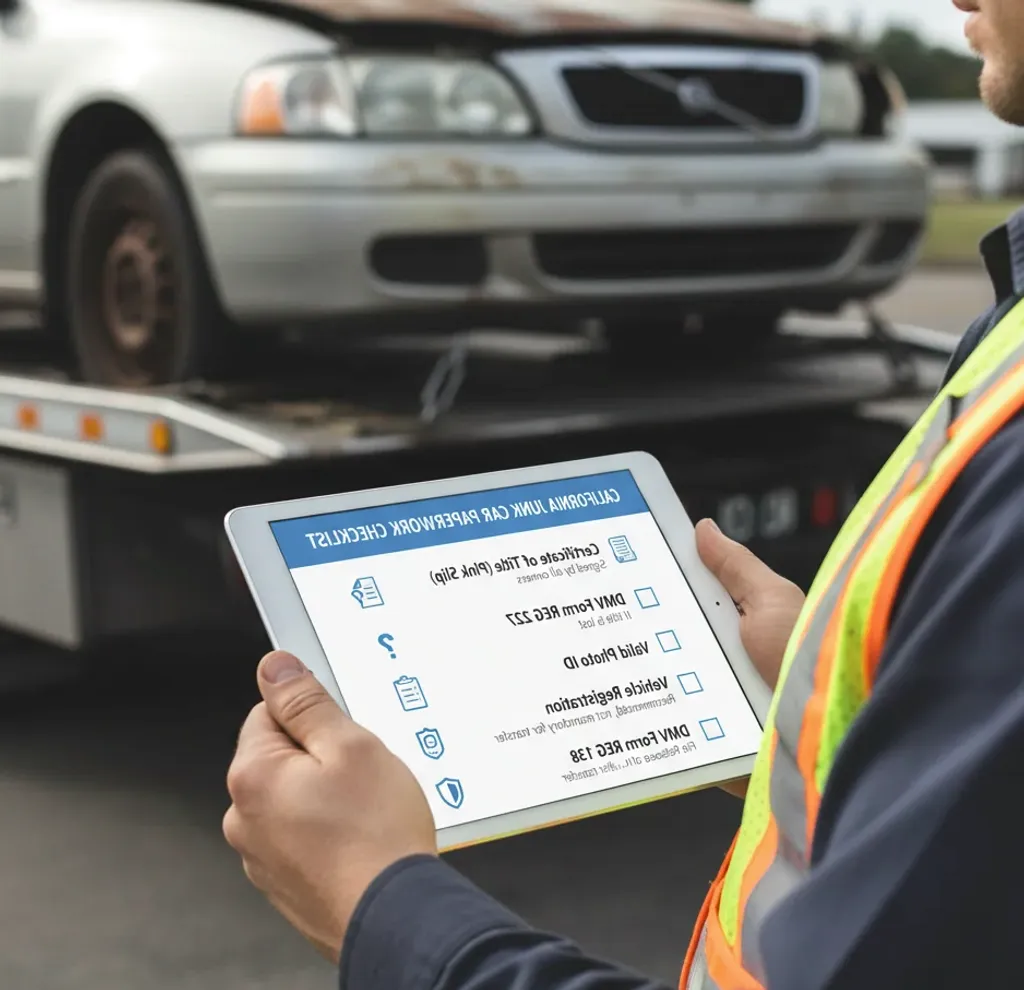
A missing title also needs a separate check. The California DMV identifies REG 227 as the Application for Duplicate or Paperless Title. That doesn’t mean every receiving yard will accept a pending application or a vehicle without its title. Ask both DMV and the yard before arranging removal.
Take clear photos of the vehicle identification number and available records. Keep the original papers secure until you know who needs them. Don’t hand documents to an unidentified pickup driver.
This matters across San Diego County, whether the car sits in an Oceanside driveway, an El Cajon side yard, or a Chula Vista parking space. The location changes the pickup conditions, but it doesn’t resolve uncertain ownership.
Ask what the receiving yard currently accepts
Call the actual receiving yard before scheduling pickup. Ask what it needs for your exact vehicle and ownership situation. Get the yard’s legal business name, address, and contact details so you know where the car is going.
Use a short verification list:
- What ownership document will the yard inspect?
- Does it accept the paperwork you currently have?
- What identification does the person releasing the car need?
- Who will receive the keys, plates, and original records?
- Will the yard provide a written receipt?
- Is the recipient a licensed dismantler?
- What happens if the pickup driver finds missing or conflicting information?
Acceptance couldn’t be confirmed as a single statewide document list. Don’t assume a title, registration card, bill of sale, or DMV form will be enough by itself. The receiving yard must explain its current policy, while DMV determines the state record process.
Be cautious if someone promises title-free pickup without reviewing the facts. The approved claims don’t support a blanket promise that every California junk vehicle can be accepted without a title. They also don’t support guaranteed payment, free removal, or acceptance in every condition.
For a vehicle on private property, confirm that the person authorizing removal has authority over the vehicle and the parking location. A voluntary junk-car pickup isn’t the same process as removing an unauthorized vehicle under California private-property towing rules.
Our junk car and abandoned vehicle removal service connects callers with independent licensed operators. The receiving business still decides whether it can accept the vehicle and its paperwork.
Separate title, registration, and junk records
California junk vehicle paperwork uses several records with different jobs. Mixing them together can create trouble later. A title, registration card, release filing, dismantler report, and Junk Receipt aren’t interchangeable.
The California DMV describes REG 42 as the Notice of Acquisition/Report of Vehicle To Be Dismantled. A licensed dismantler files REG 42. It isn’t an owner form that you should complete and present as a universal “junk certificate.”
REG 138 is the Notice of Transfer and Release of Liability. It’s the owner-side filing, but it isn’t a junk certificate. If a transaction calls for REG 138, confirm the current submission process and retain proof of the filing. Don’t assume that handing a vehicle to a driver completes every DMV record step.
A California DMV Junk Receipt is another distinct document. DMV issues it instead of an ownership certificate for a junk vehicle when an individual surrenders evidence of ownership and requests junk status. The Junk Receipt then becomes the ownership document.
If the title is lost, REG 227 is the Application for Duplicate or Paperless Title. Its existence doesn’t prove that a yard must accept the car while title questions remain. Confirm the correct sequence with DMV.
Keep copies of every signed document and receipt. Record the vehicle identification number, plate information, recipient, transfer date, and pickup details. These junk car removal records give you a clear trail if the vehicle record doesn’t update as expected.
Don’t confuse voluntary junking with a tow-yard lien sale. If the car is already held at a storage facility, read what can happen when an owner doesn’t pick up a car from a California tow yard. That process has different parties and records.
Get pickup terms in writing
Paperwork checks shouldn’t stop with DMV forms. Get the practical pickup terms in writing before anyone moves the car. A text message or email is better than relying on a phone conversation you can’t confirm later.
The written terms should identify the vehicle, pickup address, receiving business, and operator. They should also state which documents the driver expects to inspect or collect. If keys, plates, or original paperwork will travel with the vehicle, list them.
Ask the receiving yard to document any payment or charge terms it offers. The approved claims don’t establish a standard junk-car value, removal price, or statewide fee. Those figures couldn’t be confirmed for this transaction, so the yard or operator must state its terms directly.
Don’t accept blank forms. Read each field before signing and keep a completed copy. If a form describes the vehicle as sold, transferred, dismantled, or junked, make sure the wording matches the arrangement you approved.
Before pickup, photograph the car from several angles. Include the cabin, wheels, plate, visible damage, and property around it. Remove personal belongings and check the trunk, console, door pockets, and under the seats. Don’t leave personal records inside.
San Diego properties can add access issues. A car behind a narrow North Park driveway, inside a South Bay parking area, or on an East County dirt access road may need different equipment. Describe the surface, clearance, wheel condition, and whether the vehicle rolls. The operator taking the job can then explain the pickup plan and provide terms for that location.
Verify the current process with California DMV
Make DMV verification your final check, not an afterthought. Forms and procedures can change. The receiving yard’s policy also doesn’t replace the state’s instructions for the vehicle record.
Tell DMV whether you still have the title, whose name appears on it, and whether the vehicle has already been transferred. Mention any missing signatures, name differences, or ownership disputes. Ask which current form applies and how DMV wants it submitted.
For a straightforward review, confirm these points:
- Which ownership document applies to this vehicle?
- Is REG 227 needed because the title is missing?
- Does the owner need to file REG 138?
- Is the owner requesting junk status from DMV?
- Will a licensed dismantler file REG 42?
- What proof should the owner retain afterward?
Don’t state or rely on a REG 42 deadline. The approved research didn’t confirm one universal window for both parts of that form. A licensed dismantler should follow the window DMV currently sets for its filing.
The DMV’s abandoned and abated vehicle manual covers processes involving abandoned vehicles and lien sales. Those procedures aren’t automatically the right path for a voluntary junk-car transfer. Use the source that matches your situation, or ask DMV to identify it.
Save confirmation pages, reference details, mailed receipts, and copies of submitted forms. Then check the DMV record as directed. If something remains unresolved, pause the pickup until DMV and the receiving yard give consistent instructions.
When to call us
Call when a non-running vehicle needs professional loading or transport after you’ve confirmed the ownership and receiving-yard requirements. We’ll connect you with an independent licensed operator, while that operator sets the pickup terms and price. Call (858) 925-5546 to reach dispatch.